70.3 Muncie Race Report: It's Harder in the Heat
I’d say, “That Ironman was hard” but that would be needlessly repetitious. They are all hard; that’s what Ironman is, and it is part of the reason we race long, at least it is for me. But sometimes “hard” can come in different flavors; sometimes you might not even recognize that you are in the middle of “hard” until it is too late. That’s what happened to me.
I raced 70.3 Muncie last weekend; it was the 46th running of the triathlon there. In the end, things turned out well, but it was tough sledding for a while. If you are considering racing in Muncie, I hope this report provides you some helpful insight into what the race offers and how to be successful there. Along the way I’ll share a few top-tips that can maybe help you in your next race wherever it is. Here’s what went down in this Indiana town last Saturday.
The Swim
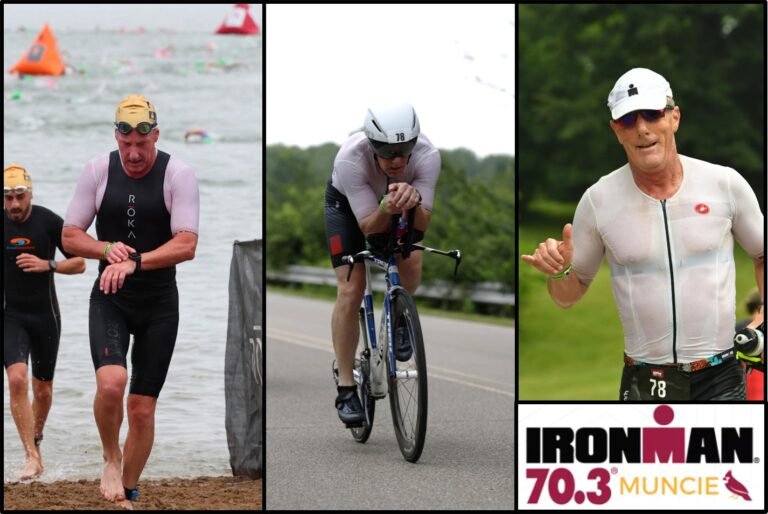
The 1.2-mile swim course features a long rectangular clockwise swim in Prairie Creek Reservoir. As a relatively shallow body of water, it had freely absorbed the July sun and was registering 84 degrees on race morning – not wetsuit legal, so it was on with the SwimSkin.
As flat as the surface appeared with no wind that morning, the water was warm, murky, and chaotic. I found myself taking extra sighting strokes to find a good line and see the buoys. I raced in my regular mirrored goggles, but clear lenses would have been a better choice on race morning.
The water temperature seemed to have an effect on my swim – my stroke was normal for a Tempo effort, but it felt a lot harder than it should have. By the third buoy I had found a good line and open swimming space, but my heart was racing and I had to throttle back. The data later showed that my heart rate was near Threshold levels instead of Tempo.
The long return leg seemed to take forever, but I was glad when my fingers finally touched the sandy bottom and I could stand up. Swim time: 39:46, over six minutes slower than I had anticipated; not a great start.
Swim Top-Tips:
- Have both mirrored and clear swim goggles available on race morning so you can choose the best option for the conditions.
- For warm-water swims, start more conservatively; your body won’t be able to shed heat as easily, so heart rates can become quickly elevated, which could cost you later in the race.
Transition 1
Coming out of the water you face a long uphill run for about 100 meters, then flat for another 50 before entering transition. At the swim exit, all my FinisherPix are beautifully framed images of me staring dumbfoundedly at my watch trying to understand what it was telling me.
The running surface is carpeted, and the TA is grassy, so it is easy on the feet. Transition was smooth, and I spent only 60 seconds stationary at the bike rack before the run out. Time: 3:35, second fastest in my age group; my heart was still racing at 167 BPM, but I was happy with the result.
The Bike
If you are looking for a scenic ride through picturesque landscapes with lots of visual interest to distract you from the race effort, this is not the race for you. On the other hand, if you want flat and fast, the 56-mile bike course at Muncie can deliver.
Leaving transition, you negotiate a five-mile “stem” section with a few sharp turns through a residential section leading to the main route. Once you take the left onto Hwy 35 it’s a straight 11-mile shot to the turn around and then 11 miles straight back. Finish two laps, and then you return along the “stem” back to transition. Along the way highlights include a gas station, a shop selling cement statuary, and some farms. That’s about it, but there are also no hills worthy of reporting, the road is in good condition, and it’s closed to cars.
In the first ten miles it felt like I was riding in London – the humidity fogged up the interior of my helmet visor making it hard to see, so I alternated putting it up and down every few miles until the problem went away. The first lap was smooth, but after the heat of the swim, I started the bike with a much higher than planned heart rate and it took the first fifteen miles to settle into some kind of sustainable rhythm.
Once there, though, it was fun. I was listening to the whirr of the road under my carbon rims, enjoying the easy speed that the day was giving me, and humming the lyrics to Reptilia in my head:
“Please don’t slow me down if I’m going too fast….”
The second lap was much like the first, though I managed to bump up the effort about five percent. Unfortunately, that didn’t translate into higher speed. I later determined that I wasn’t drinking as much as I should. My electrolyte intake was on track, but total fluid volume was about half what it should have been. Late in the bike this deficit translated into higher heart rates without a matching increase in speed. Even so, I finished the ride with a new PR for a 70.3 at 2:31; very stoked about that!
Bike Top-Tips:
- The flat profile of the Muncie bike course means there is little opportunity to sit up or coast; be sure that your training includes lots of time holding aero and pedaling continuously so you can stay efficient all the way to T2.
- In addition to calculating needed carbohydrates and electrolytes, don’t forget to consider total liquid volume; based on my sweat rate, I should have consumed about seven bottles instead of three on the bike.
Transition 2
The second transition may have also been my best ever, at one minute and 51 seconds. After a flying dismount, I ran in my socks to the bike rack. My Garmin shows that I was there for only 23 seconds, stowing bike and helmet, stepping into my shoes, and grabbing my hat, which also held my hand flask and race number, and running for the exit.
The next fastest T2 in my age group took 52 seconds longer. At an 8:00 per mile running pace, that’s like giving me a tenth of a mile head start on the run. You never know when a little free speed in transition will make the difference in getting that podium or championship qualifying slot.
The Run
The run is where it started to get hard. The half-marathon course is a very simple 6.5 miles out, and then 6.5 miles right back. It begins with a few short, sharp rollers that moderate after about three miles, making the middle miles very gently rolling. Of course, you have to face those first rollers again as you approach the finish line, so it pays to save a little something for the final push.
My intent was to start the run conservatively, but I came out of T2 with my heart pegged at 163 BPM (near Threshold) and it never went down after that, even when I was practically shuffling up some of the rises. Any idea of pace went out the window and I just kept an eye on my heart rate, determined to not let it get any higher.
The aid stations steadily passed, and I made sure to get a quality drink of electrolyte and dump ice down my shirt and under my hat at every one. The out/back nature of the course was fun because you can see the leaders coming back. As fast as they were going, their faces showed that that they were all suffering, too.
Looking back at the data, my conclusion was that the run was hard and slow because I went out too fast in the swim. In the warm water I couldn’t shed heat so my heart rate spiked trying to keep me cool, and I carried that elevated level well into the bike. During the ride my fueling was on point, but I didn’t get enough fluids, which reduced my blood volume. On the run, my heart had to beat faster to push the same quantity even as my cardiovascular system used more and more of its diminished capacity to keep me cool. Three hundred meters into the swim and I was already sabotaging my run and didn’t know it. Fortunately, help was on the way.
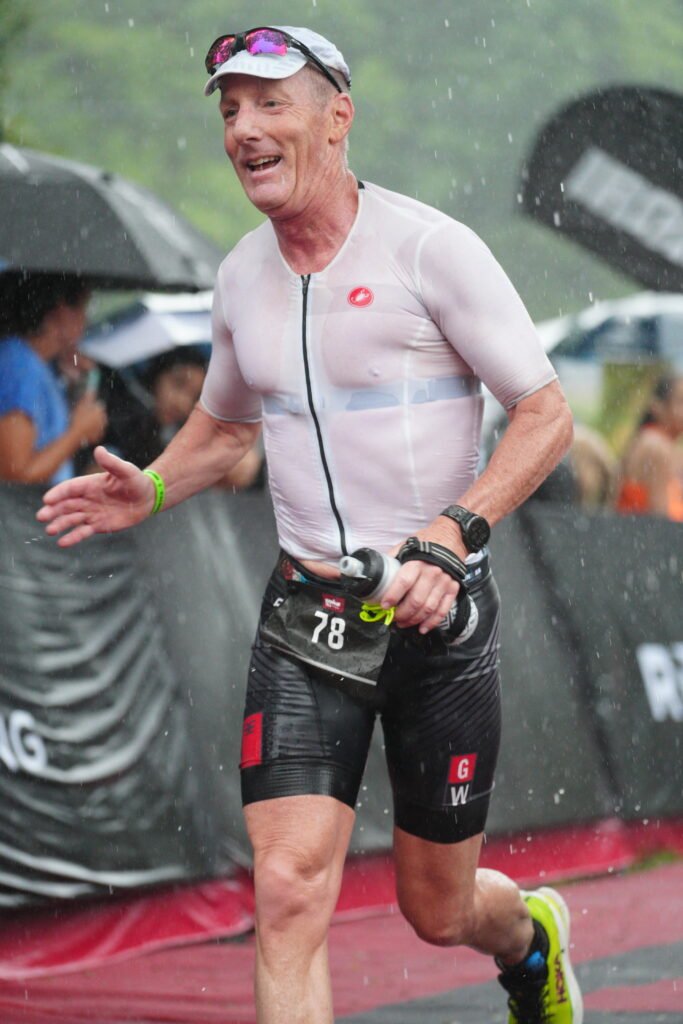
About six miles from the finish, the clouds opened up. In less than a mile the sprinkle became a deluge that continued all the way to the finish line. This helped with the cooling, but also aided my mental state. I love running in the rain!
The water felt refreshing and seemed perfectly timed for a final surge to the end. With two miles to go, I managed to lift the pace, and cross the line with a smile in 1:55. Not my fastest by a long shot, but a clear improvement over 70.3 Omaha last month in similarly hot conditions.
Run Top-Tips:
- In the heat, focus on heart rate rather than pace.
- Carrying a large water bottle hand-flask allowed me to fill it with ice and electrolyte drink so I could sip a cool, refreshing drink the entire run and top off whenever I needed to.
Logistics
If nutrition is the fourth discipline of triathlon, then logistics must be the fifth. Here are a few insider notes that I added to my personal race report.
Logistics Top-Tips:
- If you arrive early enough you can snag a parking spot about 50 meters from transition, which makes logistics super simple. After that lot fills at about 100 cars, you either have to pay to park on someone’s grass nearby (worth it!), or use overflow parking, a good quarter mile down the road. I was one of the first people there, so I got a great spot, set up my stuff, then sat in my car and did the New York Times crossword puzzle until it was time to suit up.
- The bike and run courses are on the only roads to/from the lake area, so once the race starts, the roads are closed to traffic. On the plus side, the swim is very spectator-friendly, little ones can play at the sandy beach, and I saw about five different food trucks for spectator nutrition. Just know that once the race starts, anyone with you is stuck there until about 1:00 when they open the roads again.
Conclusion
Long Course triathlon takes effort but also calculation, and every race provides an opportunity to learn and improve. My big takeaways include starting easier on a hot swim, and planning for liquid volume as well as content during the bike. Be sure to do a sweat test if you haven’t already, so you can plan accordingly as well.
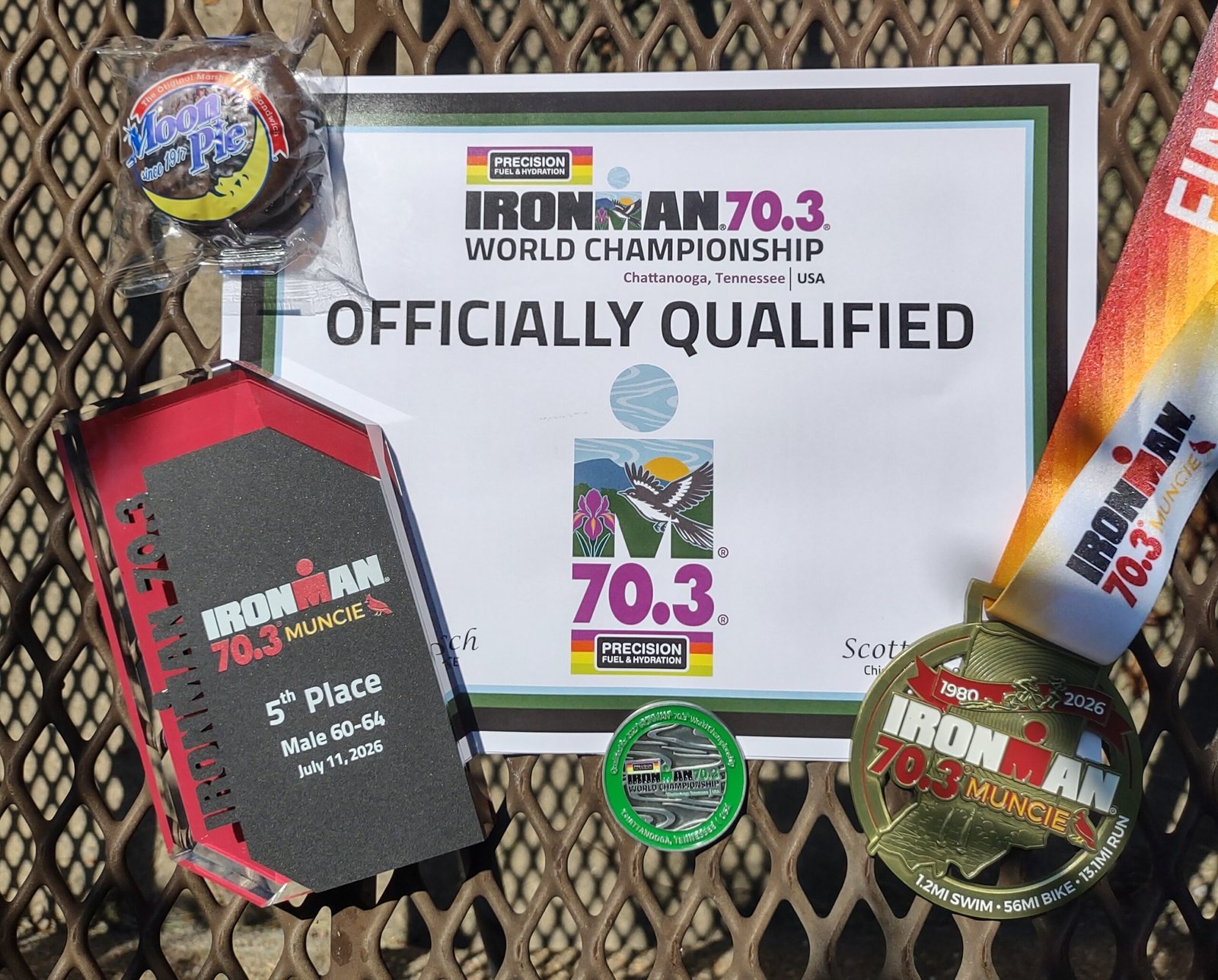
Despite those hard lessons, I still managed to claim 5th place in my age group. It’s always fun to collect a little podium hardware. Muncie was also the first North American race to allocate slots to the 70.3 World Championships of 2027 to be held in Chattanooga, Tennessee. I love racing there, and so was very happy when they called my name.
The emcee at the awards ceremony instructed us that if we wanted to accept the slot, the correct response was to pump our fists and shout “whoo-whoo” like a train. I gave my best impression of a Chattanooga Choo-Choo and jogged up to the registration tent.
As an added treat, they give you a free moon pie, so totally worth it.
Happy Training!