
70.3 Ironman World Championships Race Report: 3 Experiments Worth Repeating
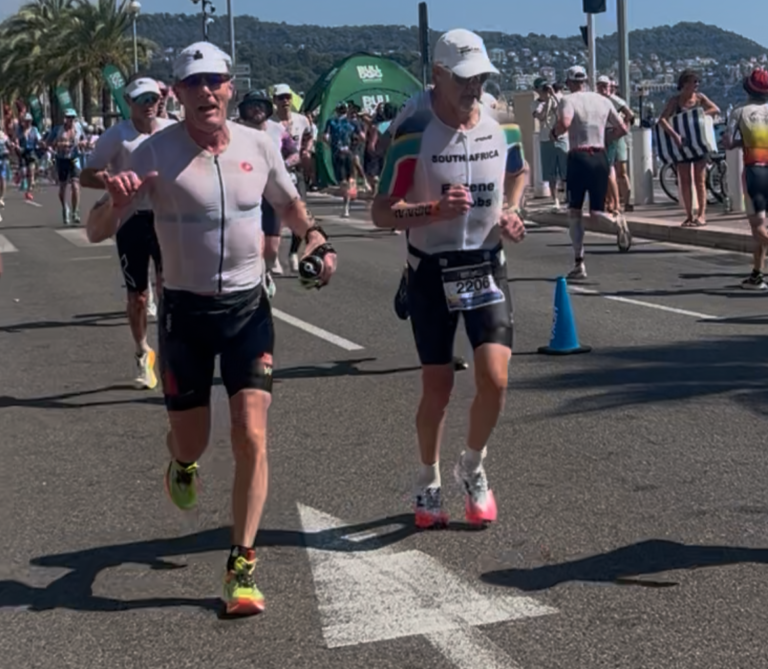
Two weeks ago I had the opportunity to race in Nice, France, at the 70.3 Ironman World Championships. The experience did not disappoint. With over 3,100 racers representing 130 countries in the men’s field, the environment was electric with testosterone, talent, and tense anticipation.
What made this race unique for me was the challenges of the course itself, and the short travel timeline I had to work with. Here are three things I experimented with to adapt to the different conditions, and the outcome of each. Perhaps you will find something helpful here wherever you happen to be racing next.
Bike Switch-a-Roo
The bike course at Nice is reputed to be the hardest of all the Ironman 70.3 races. Having done it now, I certainly agree. After six miles of flat, there is a beautiful but grueling climb that can take 90 minutes or more to complete, gaining over 4,000 feet all at once. After some steep rollers at the top, the descent is long, winding, and treacherous. In my book I write about the merits of racing on a triathlon-specific bike if you want to be competitive. But I also note that sometimes a road bike is the better choice. This was one of those times. For Nice, I rented a road bike to race on. Here was my thinking.
A good road bike is generally lighter than a tri bike, so it should climb faster. Its shorter wheelbase it is also more responsive and will corner better on the fast descents and hairpin turns. For stopping power, my aging tri-bike has rim brakes and cork pads for the carbon wheels; under heavy breaking, these can glaze over and braking ability can fade when needed most; the road bike had disc brakes and none of those disadvantages. Having the right gears for the climb was also important; unless I did a major drive-train upgrade on my tri-bike, I would have to grind at 50-60 RPM on the climb, sabotaging my legs before the run. Finally, logistically it was far cheaper and easier – no bike to break down, pack, drag through airports, and reassemble.
I brought my measurements, pedals, saddle, and a pair of clip-on aero bars to Nice, and was able to get in one practice ride. On race day, I was smiling the entire ride – with good gearing I was able to spin while others ground gears or even had to walk. The lighter frame helped me keep pace on the long climb, and the solid braking gave me confidence I wouldn’t have otherwise had on those screaming cliff-side descents. Even on the last eight-mile flat section, using the aero bars, I was able to go nearly as fast as my tri bike.
Outcome: Absolute win. For technical, hilly courses and international travel, renting a good quality road bike is well worth considering.
Climbing Math
Even with the lighter rental bike, I wondered about how else I might cut weight to make the climb faster. Should I diet and try to lose five pounds? I ran the numbers. The answer was no.
There was certainly time to do so – I had 12 weeks before race day, but how much would it help? The Col de Vence was the major climb at Nice – it’s six miles at a steady 6-8% grade. Entering the key data points into an online calculator I found that dropping five pounds would save me about 83 seconds. On the other hand, if I stayed at the same weight and instead increased my FTP by just 10 Watts, I could make the climb a full 140 seconds faster, nearly twice as much. Raising it by 20 Watts would make me almost five minutes faster.
I decided to put the scale away and focus on building power. Combining heavy leg work in the gym with long outdoor hill repeats resulted in raising my FTP by about 26 Watts over those same 12 weeks. My last climbing workouts before the race, I felt like I was flying up those hills. As an added bonus, lost weight is a benefit only when climbing, but added power on the bike helps all the time.
Outcome: Glad I did this. Focus on the power; let the body decide what weight it needs to be to get the work done.
Pre-Empting Jet Lag
There’s a seven-hour time zone difference between Minnesota and France. Our bodies generally can adapt to differences at the rate of about an hour a day. The earliest we could get to Nice was only three days before the race. That meant that at race start, my body clock would think it was still 3:00 AM. Not ideal; what to do?
I decided to experiment with front-loading the jet lag. The week before we flew, I adjusted my bed time and wakeup alarm 30 minutes earlier each day. By the time we got on the plane, I was going to bed at 6:30 PM and waking at 2:30 AM. I won’t claim it was easy or fun. I slept in the basement guest room so the change in timing didn’t disturb my wife (or the dog), and it was hard to get to sleep if I didn’t fully darken the room. But it is also true that the quiet early morning hours were really productive and I was able to get a lot done with great focus.
Once in France, the adjustment felt much easier than with previous international travel. It took about a day or so, but my body clock had effectively reset by race morning, much faster than it might have otherwise, so I felt alert and ready to race.
Outcome: It’s still better to get to the venue earlier, but this helped when I couldn’t.
OK, But How Was the Race?
Thanks for asking! The swim was one of my top five lifetime favorites – the clear aqua waters of the Mediterranean combined with salty buoyancy made the swim feel fast. The only hitch was when we turned east into the rising sun; even my mirrored goggles didn’t keep me from losing sight of the buoys for a while and going a little too wide. Despite this, I still managed to hit my time goal right on the money.
The bike lived up to expectations and was the toughest I have ever raced. Even with the lighter road bike and increased power, the long, hard climb still took me 91 minutes to complete. My effort was rewarded with spectacular views around every turn – either the switchbacks wending upwards through the canyon, or the shoreline receding far below. The descent was fast and hairy at times; some riders seemed willing to risk it all to shave a second or two. I focused on getting down safely, especially after passing by the results of three different crashes. With the tougher course, it took an hour longer than usual to finish the bike.
The run was hot, but all my heat training seemed to pay off – I was comfortable and able to hold a steady pace for the first lap, and raise the effort going into the second. My electrolyte and carbohydrate intake were exactly on point, but I didn’t account for the extra hour on the bike and was behind on hydration by a bottle or two. Unwittingly, I started the run a little dehydrated. That came back to haunt me at mile 12.5 when my hamstring cramped up in sight of the finish line, costing me 62 seconds.
After that pause, I was able to run again, crossing the finish line 102d in my age group. It would have been nice to be able to say “top 100” but that short little hiccup near the end put that idea out of reach. Even so, considering the company I was in, I figure it’s pretty decent.
It was a fun, tough day, a great experience, and a week of travel and decompression after made the whole adventure well worth it. The excitement hasn’t worn off yet, but already I’m starting to make plans for next season; after all, the 2027 Ironman 70.3 World Championships in Chattanooga are less than a year away.
Happy Training!