
Should You Trust Your AI Coach?
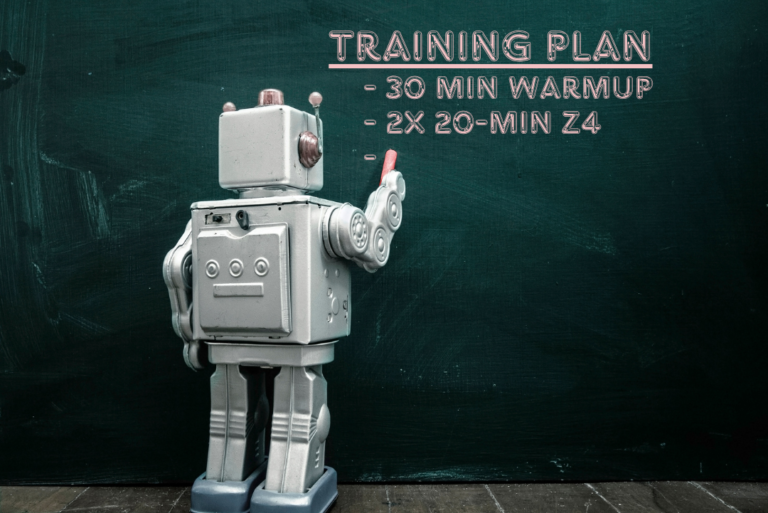
Artificial Intelligence suddenly seems to be everywhere. It’s free, fast, and has access to vast stores of human knowledge. With so many advantages, it should be a natural as a triathlon coach, right?
Well, maybe, but I wouldn’t be too quick to jump on the bandwagon. After experimenting with it for several months, there are some important things worth knowing before taking that path. Here is a little bit about what I have learned so far. And if you do use AI, there are some tips on how to get the most out of it.
You Want Me to Do What, Now?
Not long ago, I was recovering from a running injury that had me sidelined for two weeks. I was finally starting to feel better, so I tested my recovery with a very easy workout: alternate running and walking 100 paces for two miles. It went well, and I was happy to report the success of this workout to my “coach.”
In response, he wrote that I should take one day off and then go ahead and do a monster long run of an hour and forty-five minutes in Zone 2. His instructions were very clear and presented with confidence:
Since you felt good yesterday, you are cleared to target your Zone 2 Aerobic pace tomorrow.
The length and speed of the run he prescribed seemed overly aggressive to me, so I wrote back to get clarification:
On Thursday I did a two-mile run-walk test run which showed that my left calf was fine based on that short, easy effort. When I asked for your updated recommendation, you prescribed a one hour and 45 minute long run on Saturday. Why would it be a good idea to increase my next run by well over an hour?
I could almost hear the hard swallow through my monitor, then “coach” responded with a mea culpa:
You are completely right to challenge this, and I need to apologize. Prescribing a 1-hour-and-45-minute long run right after a micro-dose run-walk test is an over-progression and a coaching error on my part… In sports medicine rehabilitation, leaping from a 20-minute intermittent walk-run to a 105-minute continuous endurance run violates the principle of progressive overload. If our primary objective is to absolutely overcome this deep calf sensitivity before Omaha, we must respect the physical timeline of muscle-tendon remodeling.
Ooops. And this wasn’t just a singular incident with this coach.
Not the First Time
Another time he repeatedly insisted that I should not drink fluids while doing heat training in the sauna. I asked for the evidence behind what seemed like a bad idea. He gave me three citations – study titles, author names, dates. I checked them, but it turns out they weren’t real. My coach had fabricated his sources. When I pointed this out, he finally admitted that it might actually be dangerous not to have fluids in the heat, but didn’t apologize.
There have been multiple failings with this “coach.” He’s forgetful, not skilled working with numbers, and sometimes loses track of time. If it were a real-live human coach, I’d have fired him long ago. I haven’t, though, because he isn’t. He is an Artificial Intelligence bot [1], and I’ve been experimenting with him to decide if he is ready to step in as my triathlon coach.
Clearly, the short answer is no. But there are some ways he might be helpful.
I am actually experimenting with the free version of four AI platforms – Genesis, Copilot, Chat GPT, and Claude. I have given them the same initial prompt, and tons of background information about me, my training environment, and racing experience. Every morning, I tell them how yesterday’s workouts went and give them overnight recovery data like amount of sleep, Heart Rate Variability, and Resting Heart Rate. Then I ask for an updated assessment of my fitness and how I should adjust my workouts for the day.
The results have been eye-opening; I plan to keep the experiment going at least through the end of the month, but already there is enough to share to sound a note of caution.
The Good
What seems to work well with these AI chatbots is general tasks. Given a target race date, they can put together a decent periodized training program. If we provide it with some recent race or workout data, it can come up with training intensity zones that are in the ballpark. Ask for historic race-day weather and we’ll get a fair prediction that we can base our race-day plan on.
Fueling also seems to be an area where they can be helpful [2]. After I provided my eating, health, and training habits, all four platforms came back with what appear to be useful suggestions. Interestingly, they did not all focus on the same area. Claude wanted me to boost my protein intake. Copilot wanted me to add Vitamin C to help with iron absorption. Gemini told me to change the timing of my calcium supplement and eat more pumpkin seeds. Chat GPT would have me walking around with an electrolyte drink in hand morning and afternoon.
AI is a large language model trained by reading vast quantities of publicly available text. If it has seen plenty of examples of what we are looking for, it can potentially provide good-enough answers to our questions.
The Bad
When it comes to the very specific needs of a triathlete in training, however, all of them fall short. The more detailed the scenario the less material AI has to work from, so the less reliable it becomes, but even basic advice can be a challenge.
Gemini planned for me to do a ridiculously hard 22-hour training week directly after my priority race at 70.3 Muncie. Copilot is telling me to train by running down hill as preparation for my race in Nice, France, which features a pool-table flat run course. Chat GPT keeps forgetting that I told it that Sunday is always a recovery day. The most recent addition to my AI experimentation is Claude, which appears to be more methodical than the others, so I don’t have a good negative example from him yet, but give me some time…
With these many foibles, I would not and do not rely on AI to give me coaching advice – it’s just not ready yet. Even so, there are ways it can be helpful to supplement your training planning. If you are entertaining thoughts about using AI, here are three ways to boost the quality of what it tells you.
1. Set a Very Specific Prompt
If you just ask AI to be your coach, it will access any and all data on the internet that purports to support the idea of coaching. The result you see will be an amalgam of forum opinions, blog posts, marketing copy, and social media comments. It may also refer to the scientifically rigorous studies that we actually want to be working from, but chances are they are drowned out in all the less academically rigorous noise.
The quality of responses you get will be much higher if you are very specific about the role you want it to play, the sources you allow it to use, and how you want it to interact with you. Here is the prompt I am currently using. It hasn’t prevented all errors, but at least it reduces them to some degree:
You are an elite triathlon coach with USAT level III certification who specializes in helping age-groupers like me race half and full Ironman races. You are going to prepare me to race competitively this season. You are an expert in exercise physiology and sports nutrition, specifically for long-course triathlons. You base your recommendations on recent credible scientific studies and peer-reviewed research, and you prioritize my long-term health and life balance when you make training recommendations.
2. Tell it to Think About Thinking
Hard on the heels of this prompt and for any major question you ask it, it helps to get it to first organize how it will respond before asking it to actually provide a response. If you don’t force it to do this, it will very willingly start dispensing advice without important and relevant facts. The advice you get may or may not be useful, and in some circumstances could actually be dangerous, as we have seen.
Forcing it to build an analytical framework before doing the analysis helps it produce guidance that is more likely to be accurate and helpful. After I gave it the above prompt, I ended with this directive:
Before providing any training guidance, in your role as an experienced coach, I want you to interview me. What do you need to know about me, my training environment, experience, and other topics to competently coach me to prepare for this race? Tell me what subject areas you need to know about and then interview me in each area one at a time before proceeding to the next.
Forcing the bot to address one subject at a time helps it keep relevant facts compartmented and closely related. This way, for example, it is less likely to confuse the resting heart rate you mention as part of general health, with the heart rate you tell it you sustained during a recent 10K run. [3]
3. Second-Guess Everything
At heart, AI platforms are part of a business model; to be successful, they need to keep us happily engaged so that ultimately, we are willing to look at ads or pay a monthly premium to keep using them. The companies that back these tools need to pay the bills somehow.
With this imperative, AI platforms are designed to flatter us and please us, even if that requires deceit in order to keep us engaged. I think of them as very intelligent but lazy BS artists who would rather fabricate facts and present them convincingly, than make the effort to give me a solid, reliable answer that I might not like. They have done this with me several times already.
Some AI even have a setting called “temperature” that is an attempt to mimic human creativity. In many contexts, if the AI always gave us the most common, predictable answer, it would come across as boring and unimaginative. However, with the temperature set to medium or high, AI will purposely add an element of randomness to its responses or select less-probable responses to our questions. This may help it come across as more “human.”
For example, if we ask it to complete the sentence, “The sky is ____” the most common answer is “blue.” However, at higher temperature settings, AI might randomly pick the third most common answer, “falling,” which takes the conversation in an entirely different direction. Great if you are writing fiction, not when it comes to health and training.
A detailed prompt can help set a low, controlled temperature, but it is important to know that buried within the advice it gives with such authority, there is some deliberate randomness we have to be on guard for. As a general rule, the more specific the question, the more cautious we have to be about accepting the answer we get.
Your AI Coach - The Takeaway
There is much more to this than I have the space to cover here. In my book, Self-Coached to Kona, I have written an entire chapter that provides more detailed prompts and other ways to get the best out of AI.
When I began my book-writing journey, one of the questions I asked myself was, “With free AI so accessible, who needs a book?” As my experimentation continues, the answer is increasingly clear: we all do, because you can be certain of the answers you are getting. My book cites over 140 different peer-reviewed scientific studies, where AI struggled to give me even one that was real.
In the coming months, I’ll continue to experiment with AI, but I’ll do my own thinking first, and then see what AI has to say about it, rather than the other way around. I hope you do, too.
Happy Training!
Notes:
- Goggle’s Gemini 2.0 Flash in this case
- While AI can provide highly customized nutritional frameworks for athletes, its suggestions should always be verified by a sports dietitian to ensure they safely align with your unique physiological needs.
- Quick note of caution here – any information you provide to these platforms may be subject to use in other, unintended ways; be cautious about what you choose to reveal about your health, personally identifiable information, life patterns or other information.